Skip to content
  (650) 442-1470

 (650) 442-1470

Summary:
To tell how much hot water your home uses, look at how much you typically use on average and during your busiest hour each day. Start by counting how many times each person showers, bathes, or runs the washer and dishwasher per day or week. Compare this to the total flow rate for each fixture or device, if known. Free calculators make it easier to calculate based on household size, but should never replace advice from a licensed plumber.
| Time to Read | 6–8 minutes |
| What You’ll Learn |
|
| Next Steps |
|
Find Out How Much Hot Water Your Home Needs (Free Calculator)
Most homeowners don’t really think about how much hot water they use until they start running out of it again and again. While this can sometimes point to an issue with a hot water heater’s element or burner, the number one cause is exceeding the total available capacity instead.
It happens slowly over time. Families grow. Mom or dad moves in. The kids turn into teenagers who see the shower as their personal retreat. Little by little, demand rises until there’s just not enough to go around.
Use the free calculator below to estimate how much water your home actually uses by the day, week, month, and year. Then, send us a message to upgrade to a water heater that better meets your needs.
Hot Water Consumption Calculator
Enter your info into the tool, then click “Calculate My Hot Water Needs” to get your estimate. Click “Reset” any time to start over. We recommend starting with the basic Household Inputs, including the Additional Use section, first. Your best guess is fine!
ProTip: If you already know the GPM flow rate for your appliances, or you have older appliances, click on the Advanced Settings box. It’ll give you more precise control over the calculation.
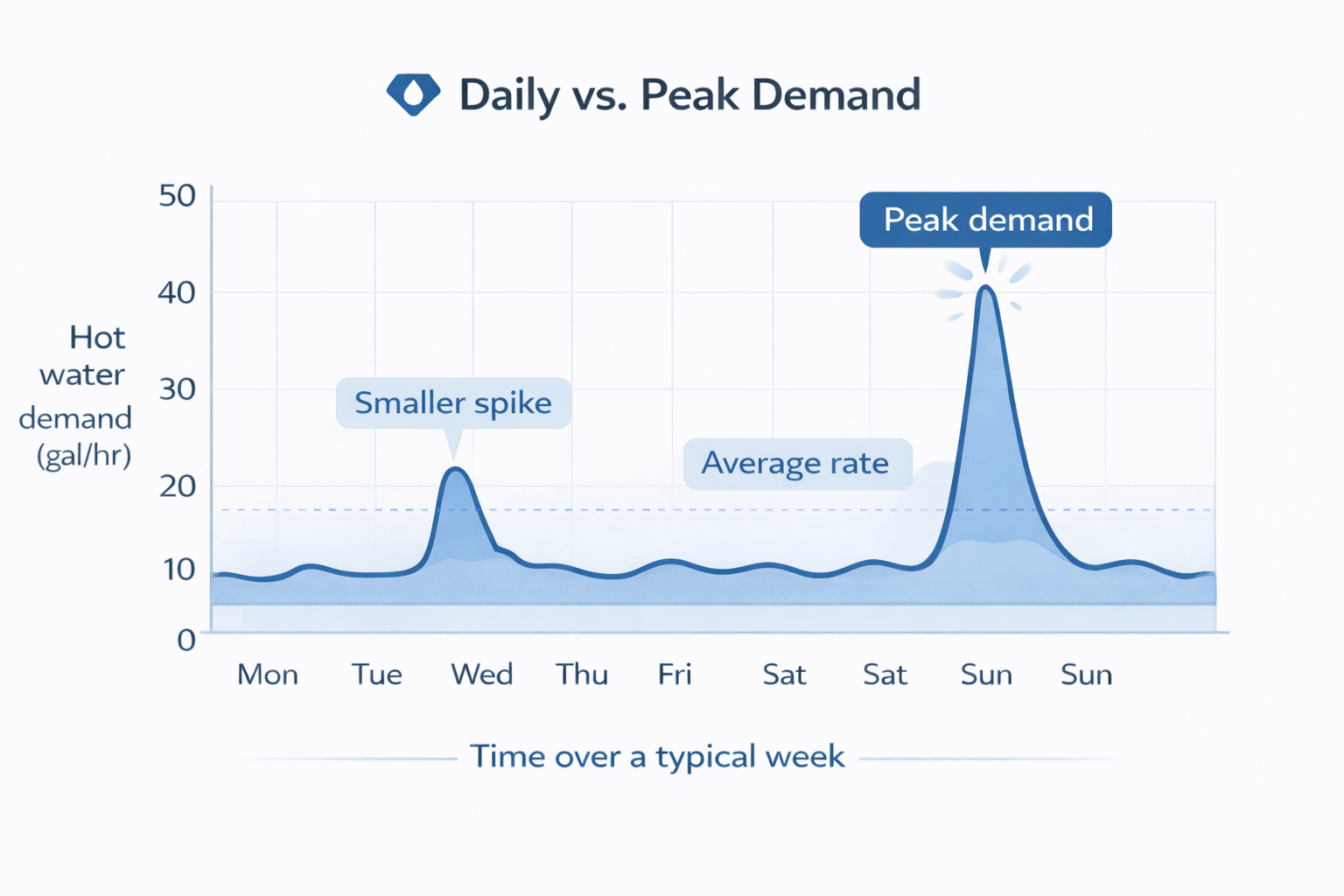
The Difference Between Daily and Peak Demand
Your household doesn’t use hot water at the same rate all day long. Usage stays fairly consistent for most of the day, then spikes during busy periods like in the morning and after dinner.
The more spikes you have, and the more significant those swings are, the higher your overall demand will be. This is why it’s never wise to pick a water heater based on averages alone. At best, it will leave you with a water heater that only performs well less than a quarter of the time.
How Seasonal Shifts Affect Your Water Heater
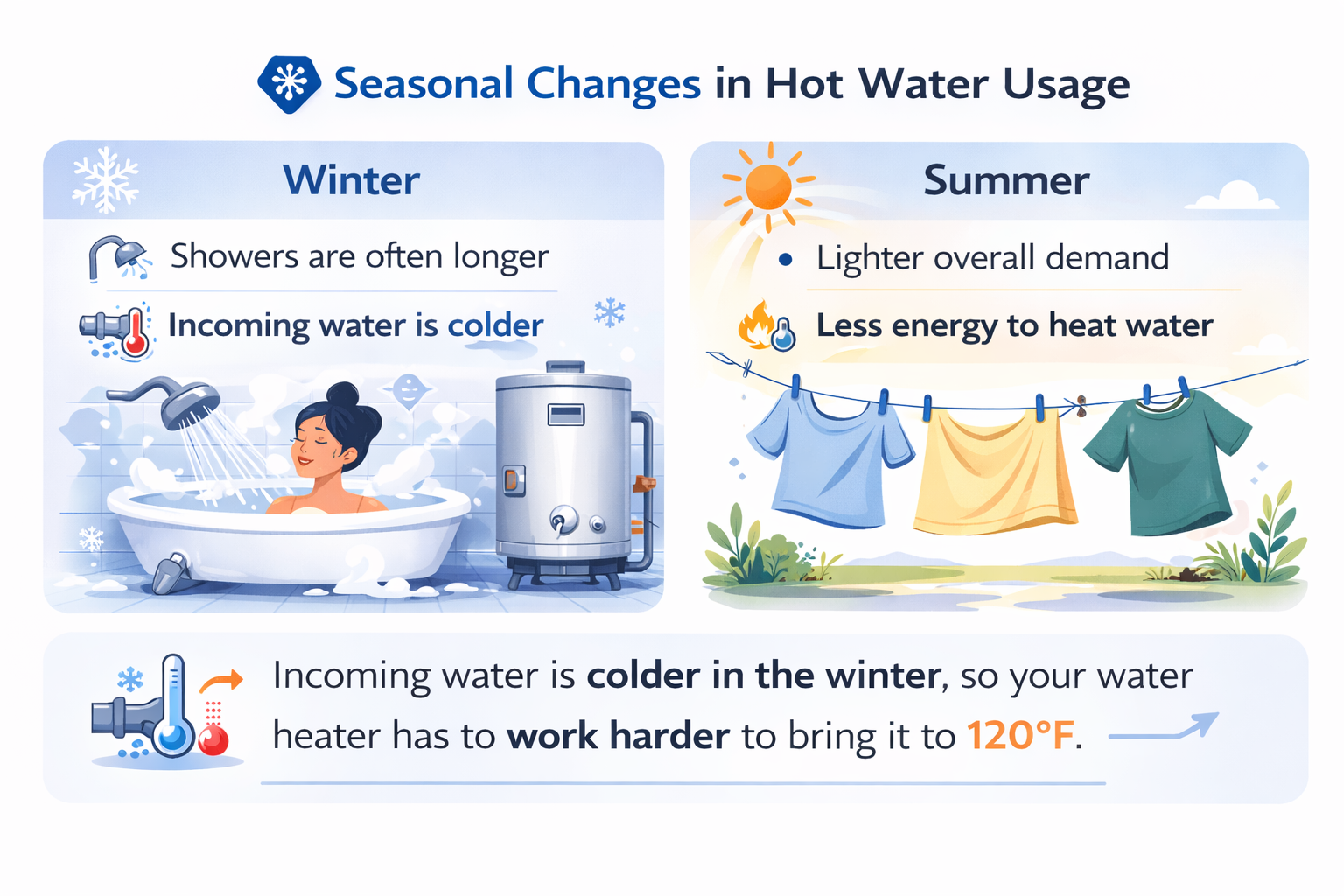
The average year-round temperature of incoming water is around 60°F in the Bay Area, but numbers can be much lower in the winter or slightly higher in the summer. The colder the water is, the harder your hot water heater needs to work to bring it up to 120°F or higher.
Too Big, Too Small…or Just Right?
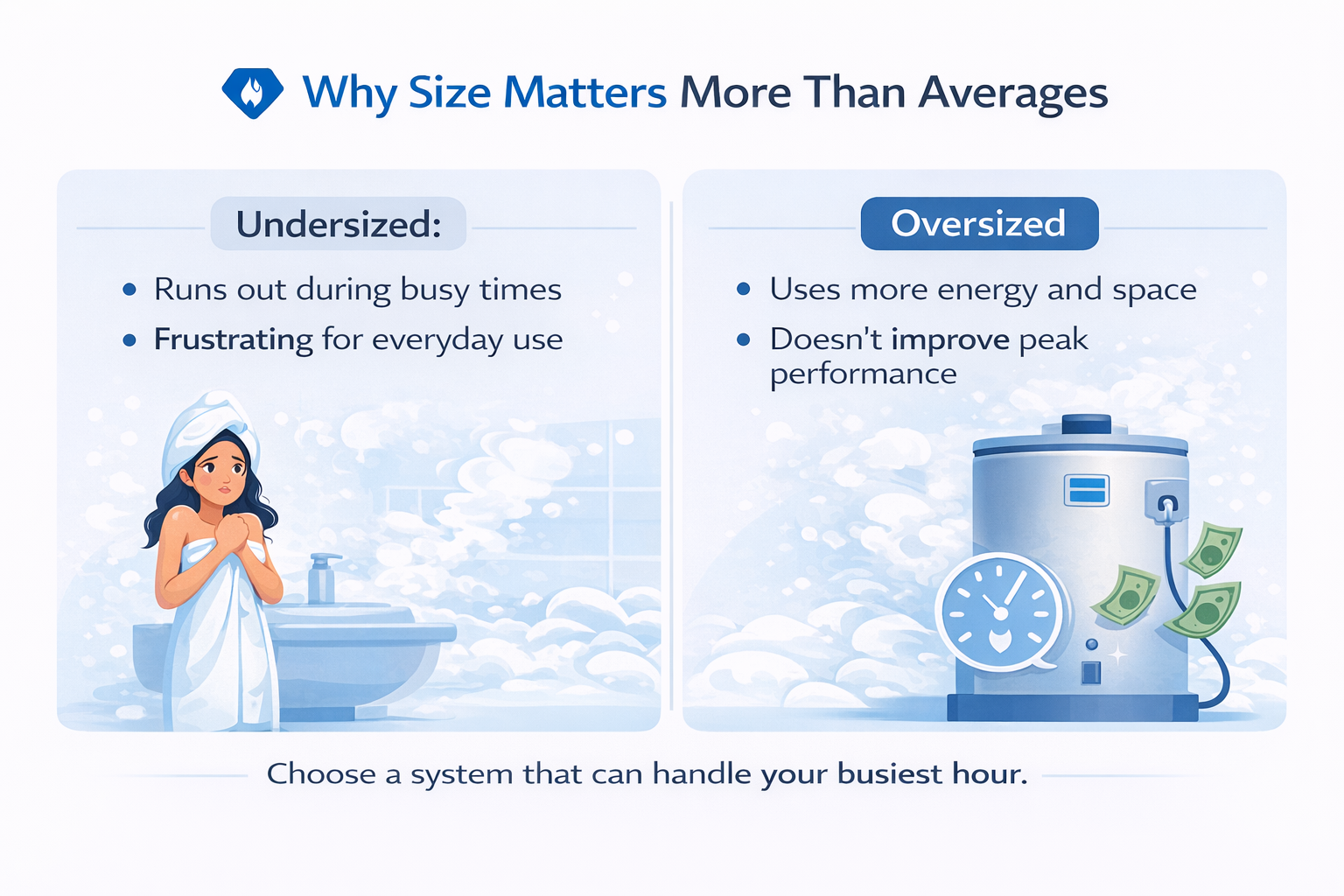
More capacity equals more coverage, but that doesn’t necessarily mean you should rush out and buy the biggest and most expensive water heater on the market. A unit that’s constantly trying to heat up more water than you’re actually using can be incredibly inefficient and expensive to run.
So, what’s the goal, then? Find a water heater that can keep up with your busiest hour of use without wasting energy unnecessarily. This is why it’s important to look at factors like family size and usage patterns instead of just tank size, GPM, or features.
How to Tell if It’s Time to Upgrade
If the calculator tells you it’s time to upgrade, you probably need to consider installing a higher capacity unit at some point in the near future. That said, capacity isn’t the only reason to upgrade. Explore the most common symptoms, what they actually mean, and what to look for to fix them in the chart below.
| Symptom | What It Usually Means | What to Look For |
|---|---|---|
| Hot water runs out faster than it should. | Demand is generally outpacing capacity. |
|
| Using multiple fixtures causes temperature swings. | Your storage (tank) or total GPM (tankless) is insufficient. |
|
| Back-to-back showers run cold. | The recovery rate is too slow for your needs. |
|
| Your water heater is 10+ years old. | Older units are less efficient and more prone to sudden failures. |
|
| Low water pressure on hot water only. | Sediment or hard water scale restricting the flow. |
|
Choosing Between Tank-Based and Tankless
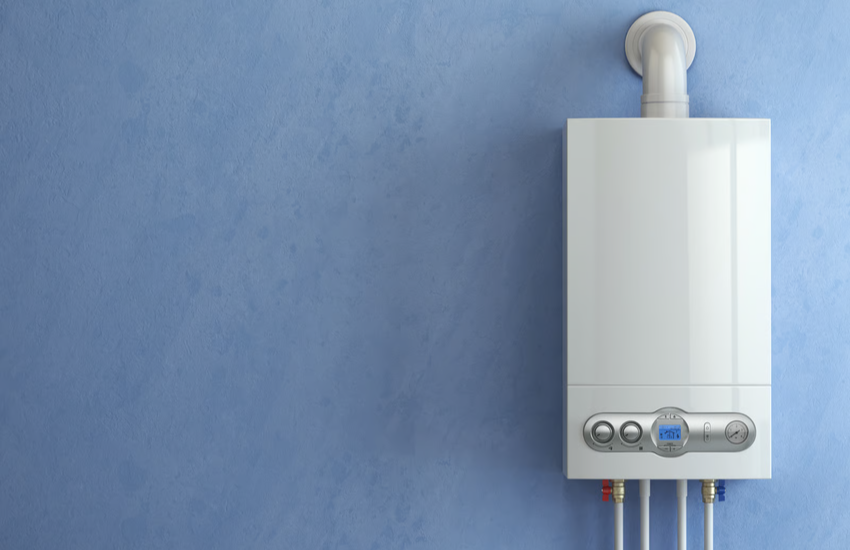
Once you have an idea of whether it makes sense to upgrade, it’s time to start thinking about the type of unit you want to invest in. The two most popular water heater options here in California are tank-based and tankless. Use the table below to compare the different benefits they offer homeowners.
ProTip: Heat pump water heaters are technically tank-based systems that are powered by a built-in heat pump. They’re different enough that we felt it made sense to list them separately here.
| Factor | Standard Tank-Based | Tankless (On-Demand) | Heat Pump Water Heater (HPWH) |
|---|---|---|---|
| Upfront Costs | $ | $$$ to $$$$ | $$$$* |
| Delivery Style | Stored in tank | Continuous on demand | Stored in tank, reheated efficiently |
| Available Capacities | 40 to 80 gallon tank | ~2 to 11 GPM for whole home >1.5 GPM for point-of-use | 50 to 80 gallons |
| Best For | Moderate demand | High demand | Moderate demand |
| Risk of Running Out? | Yes, if tank depletes | Only if demand outpaces total GPM | Yes, if tank depletes |
| Energy Efficiency | Standard | High | Very high |
| Savings Over Time | Moderate | Moderate | Lowest in many cases |
| Space Requirements | Large footprint | Compact and wall-mounted | Large tank plus air space |
| Typical Lifespan | ~8 to 12 years | ~15 to 20 years | ~10 to 15 years |
*Homeowners who install a heat pump water heater may be eligible for rebates through local utility providers or programs like Tech Clean California. See our Rebate Finder for more information.

Ready to Upgrade? Talk to Caccia Home Services First.
Our hot water consumption calculator is definitely a great starting point, but it can’t account for special scenarios, plumbing code, or California’s complicated regulations. That’s why it still makes sense to seek a little advice from the experts at Caccia before you start shopping around.
Our local plumbers have installed, repaired, and replaced plenty of hot water heaters over the years, so we know what works (and what doesn’t). To get help finding a system you can rely on for years, just send us a message!
FAQs About Hot Water Use in The Home
How do I know if my current water heater is the right size?
If you’re regularly running out of hot water during busy periods, your unit is likely undersized. But the opposite is also true: if you never run out of hot water, you probably aren’t at the point where you need to upgrade to a new system yet.
Efficiency is the main exception. Very old water heaters are notoriously inefficient, so even if you aren’t exceeding the capacity, it may still make sense to switch to something with a better rating.
Does water quality affect how a water heater performs?
It definitely can. Hard water causes minerals to build up within the tank and on the heating element itself. Over time, this can make the water heater less efficient or even shorten the lifespan of the components themselves. Inspections can help spot this early and address it so you’re less likely to spring a leak.
Installing a water softener or filter can also help, but it’s important to choose one based on what’s actually in your water. You can buy an inexpensive testing kit at your local hardware store (or just call us!).
What’s the difference between a first-hour rating and tank capacity?
Tank capacity tells you how much hot water a unit holds, but first-hour rating (FHR) tells you how much it can deliver in the first hour of heavy use. Most usage calculators (including ours!) measure peak demand the same way, so a higher FHR can actually be more useful than volume or GPM alone.
To simplify, a 50-gallon tank with a high FHR will often outperform a 60-gallon tank with a slower FHR during peak periods of use. It’s also what makes being the last one in the shower miserable!
How long should I expect my new water heater to last?
The better you maintain it, the longer it’ll last. Standard tank units typically last somewhere between 8 to 12 years, while tankless systems can last up to 20 or more with proper upkeep. Heat pump water heaters generally fall somewhere in the middle of that range.