 (650) 442-1470


 (650) 442-1470
The situation
An older cast iron sewer lateral
The customer’s existing sewer lateral was approximately 60 feet long and made from cast iron with bell-and-spigot joints. They were once the standard for many Bay Area homes.
The problem is that iron sewer lines tend to develop corrosion, weakened joints, and other structural problems as they age because the metal used in them is so prone to oxidation. While it is technically possible to repair these failures as they happen, it’s rarely practical. That’s why our plan for this project was to replace the entire lateral at once instead.
The method
Why we used a sewer pull
In a traditional sewer replacement, plumbers would need to excavate the earth completely to reveal the buried length of pipe. Tearing up landscaping, cutting through a driveway, or removing other hardscape is both expensive and much more difficult to remediate after the fact.
Pipe bursting is a less disruptive option available to some homeowners.
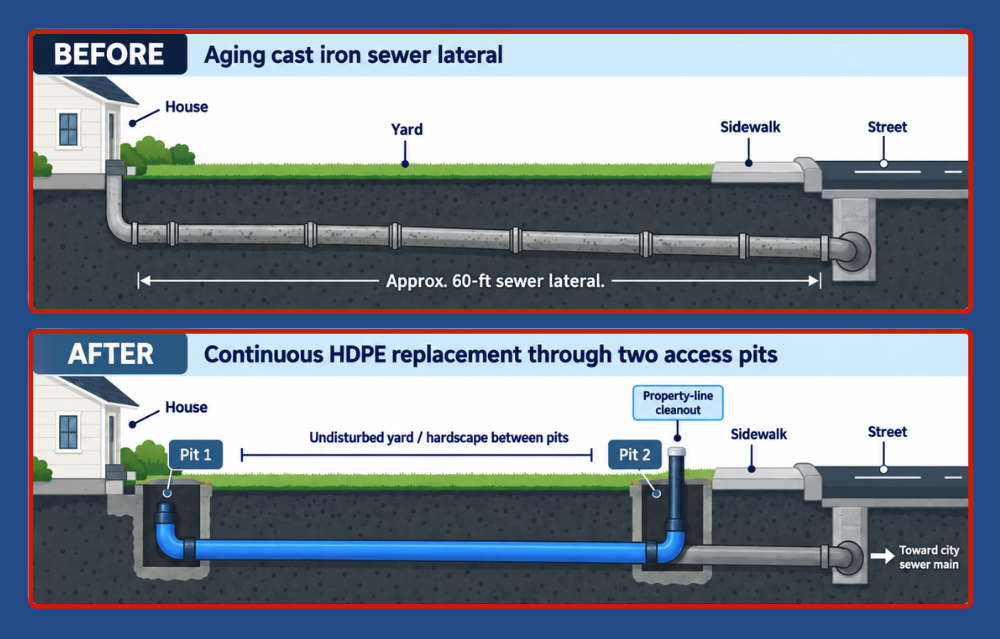
Pipe bursting replaces the full lateral through two access pits, leaving the yard and hardscape between them undisturbed.
Rather than digging a full trench, plumbers excavate two access pits on either end and feed a steel cable through the old sewer line. They attach a cone-shaped bursting head to the cable and pull it through the existing pipe.
As the head of the device moves forward, it breaks apart the old cast iron and pushes the fragments into the surrounding soil. The crew pulls the new high-density polyethylene (HDPE) pipe into place directly behind it. Any cast iron left behind harmlessly degrades into the soil over time.
Inside the job
Watch the full sewer pull, from digging the access pits to pulling the new HDPE line into place. Turn the sound on to hear the cast iron crack.
Digging the access pits
Gio and Kevin began by preparing the worksite and bringing in the equipment needed to carry out the sewer pull. This included a saw, mini excavator, and hydraulic pulling rig.
Kevin operated the excavator while Gio worked as a spotter on the ground. Together, they carefully removed the earth around each end of the lateral until they had exposed enough of the old pipe.
Coordination is particularly important on jobs like these because the technicians need to consider what the next stages of the work will involve. Where and how they excavate, for example, affects how easily they can position their equipment and make the necessary connections later. If there’s not enough room to work, they may need to stop and expand the excavation before continuing.
The two pits serve different purposes during the replacement. At the pulling end, the crew needed enough room to position the hydraulic rig and cable rollers. At the opposite end, they needed space to guide the new HDPE pipe into the existing underground route.
Preparing the old cast iron pipe
Once enough of the sewer lateral was exposed, Gio put on protective equipment and used the cut-off saw to open the cast iron at the pulling end.
Cutting through strong metal like this is no easy task. In fact, it was demanding enough that he needed to change saw blades partway through the job. We always stock our trucks with extra parts and equipment before they’re dispatched, so our plumbers typically have these on hand.
After finishing the cut, Gio broke out a short section of the old pipe by hand. This allowed the crew to begin setting up the hydraulic pulling equipment, starting with the reaction plate and cable rollers.
The reaction plate provides a solid surface for the hydraulic rig to brace against during the pull, while the rollers help guide the steel cable into the sewer line. Both need to be correctly positioned to handle the considerable force involved in breaking apart the cast iron.
Pulling the new HDPE pipe into place
The crew was finally ready for the most demanding stage of the job: pulling the new HDPE lateral into place through the old cast iron.
They secured the pulling equipment and fed the steel cable through the old lateral. Gio then started operating the hydraulic rig, drawing the bursting head through the cast iron until the pipe began cracking apart under the pressure.
The thicker bell-and-spigot joints were particularly demanding. Rather than rushing the process, the crew maintained a slow, steady pulling speed so they could monitor changes in resistance as the head advanced. Close coordination between all three technicians ensured they could make adjustments as needed without placing unnecessary strain on the equipment or replacement pipe.
Meanwhile, the crew fed the continuous HDPE pipe into the old line behind the bursting head. They continued until the new pipe occupied the same underground route as the original cast iron lateral.
Installing the cleanout and preparing for inspection
The crew turned their attention to the new two-way cleanout installation and riser next.
Gio began by fitting the two-way cleanout into the sewer lateral. He then attached a vertical riser to bring the access point up to ground level, measured it, and cut it to the finished grade. He also used banded couplings to join the necessary sections, creating tight, leak-resistant connections that help keep the pipes properly aligned.
Two-way cleanouts give plumbers and other workers easy access to the line so they can inspect it or clear it in either direction. It’s an essential step that allows us to service the line for you without constantly needing to re-excavate buried pipes in the future.
Sewer lateral replacements must be inspected by the city, so the crew couldn’t fully backfill the pits just yet. Instead, they focused on tidying up the surrounding area as much as possible. Then, they swept up the worksite, secured the excavator to its trailer, and packed up all remaining equipment.
Local sewer rules
Why property-line cleanouts matter
Local plumbing codes can affect where a cleanout must be installed and what homeowners are responsible for maintaining afterward.
In San José, for example, homeowners must install an approved property-line cleanout when they repair or replace a sewer lateral at the property line. The cleanout must be located within five feet of the property line and accessible through an approved concrete box.
When an approved property-line cleanout is installed, the City will clear qualifying blockages between that cleanout and the public sewer main at no cost to the property owner. Other Bay Area municipalities have different requirements, so the rules may be different in your neighborhood.
The results
A new sewer line with less excavation
For the homeowner, the biggest improvement is a continuous HDPE lateral without the old pipe’s intermediate bell-and-spigot joints. It eliminates the most common points for leaks and root intrusion to occur, and the material itself is both corrosion-resistant and more suitable for underground use.


