(650) 442-1470

 (650) 442-1470
Summary:
Ford’s Power Promise program is still available, and it’s helping Bay Area drivers who own Ford EVs buy and install a Level 2 home charger for free. While the program is now limited to the F-150 Lightning and Mustang Mach-E, and ends July 6, 2026, there’s still time to take advantage. For a Level 2 charger, you’ll need to have a dedicated 240-volt circuit installed first. ChargePoint, Emporia, Grizzl-E, EVIQO, Autel, and Lectron all remain popular choices.
| Time to Read | ~6 minutes |
| What You’ll Learn |
|
| Next Steps |
|
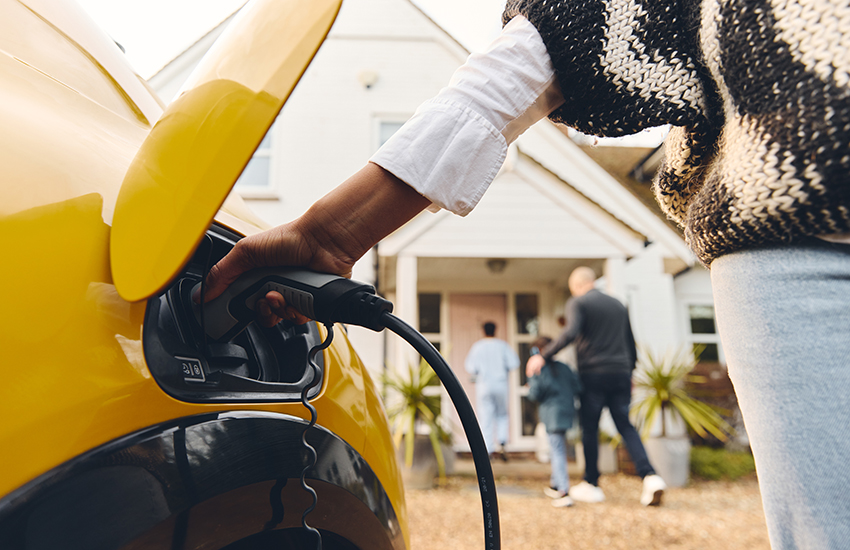
Thinking about buying a new Electric Vehicle (EV) or installing your own EV charger at home? Ford’s “Power Promise” program can still help you get in the driver’s seat without having to rely on public chargers here in the Bay Area.
The vehicle manufacturer had originally planned to end the program in 2025, but chose to extend it again late last year. That means you can still get a free Level 2 Charge Station Pro with free expert installation if you buy their F-150 Lightning or Mustang Mach-E soon.
You only have until July to claim this offer, so get the latest info on how to take advantage below, then give us a call at Caccia right away to get the ball rolling.
Top Electric Vehicles in California: Sales & Charging Capabilities
California is still at the forefront of electric vehicle (EV) adoption. Nearly 30% of all new cars sold in the state are now electric, a record high. Thanks to the rapid rollout of more than 200,000 public and shared private chargers across the state, it’s also easier than ever to charge your EV locally.
Sales numbers from Good Car, Bad Car suggest that Americans are still tightly focused on a small handful of top-performing vehicles and brands. Get a quick peek at them in the table below.
| # | Model | Charging Type | Range (miles) | Special Features |
|---|---|---|---|---|
| 1 | Tesla Model Y | Level 2, Supercharger | Up to 330 | Access to Tesla’s Supercharger network |
| 2 | Tesla Model 3 | Level 2, Supercharger | Up to 358 | Industry-leading range for the price |
| 3 | Chevrolet Bolt EV | Level 2, DC Fast Charging | Up to 259 | Affordable pricing with a solid range |
| 4 | Ford Mustang Mach-E | Level 2, DC Fast Charging | 224–312 | Fast acceleration for an EV |
| 5 | Nissan Leaf | Level 2, NACS | Up to 303 | Native access to Tesla Superchargers |
| 6 | Hyundai Ioniq 5 | Level 2, Ultra-Fast DC | Up to 303 | Charges 68 miles in just 5 minutes |
| 7 | Kia EV6 | Level 2, Ultra-Fast DC | Up to 310 | Shares tech with Ioniq 5, fast charging |
| 8 | Rivian R1T | Level 2, DC Fast Charging | Up to 314 | Great for work and hauling |
| 9 | Lucid Air | Level 2, Ultra-Fast DC | Up to 516 | Longest EV range on the market |
| 10 | Volkswagen ID.4 | Level 2, DC Fast Charging | Up to 275 | 10%–80% charge in as little as 28 min. |
Tesla’s cars are obviously the most well-known and popular, so it isn’t surprising that they take up the top two spots. Alternatives from companies like Chevrolet and Nissan are quickly catching up, though, because they’re easier on the pocketbook.
Choosing the Right EV Charger For Your Home
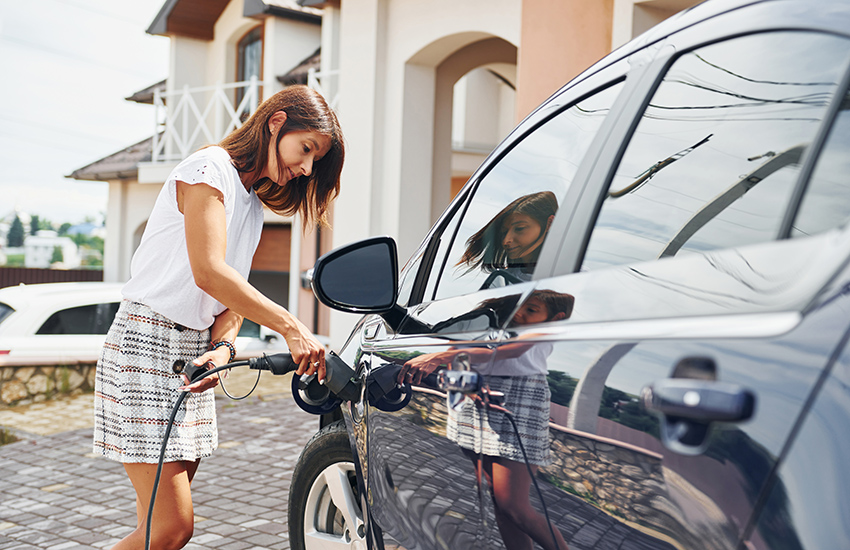
Buying your new vehicle is the first step in the process. But unless you enjoy the thrill of taking your chances with finding a publicly available spot on the fly day-to-day, it’s always more reliable and cheaper to charge at home.
This is where a lot of shoppers get stuck. Not all EV chargers are created equal, and they aren’t necessarily cross-compatible with every vehicle, either.
So let’s break down the basics:
- Level 1 chargers are the simplest option, and only need a 120-volt outlet to function. This is the same US-standard size outlet you’ll find in most homes, which can help simplify the process of installing a new charger. The main drawback is slow charging (as low as 3 to 5 miles per hour).
- Level 2 chargers are the next step up and offer a faster charging experience for compatible cars. They rely on a 240-volt outlet connection. That’s the larger-sized outlet typically used for home appliances like washers and dryers. You’ll also need to add a dedicated circuit to your electrical panel, but we can help you with that!
- DC Fast chargers are the cream of the crop. They can restore up to 80% of a vehicle’s battery charge in under 30 minutes, which is ideal if you know you’re going to be running out the charge quite often. The only problem? They’re expensive and require a dedicated high-voltage connection, which is exactly why you’re more likely to find them at public charging hubs instead of in homes.
So, which option is best? It depends on the vehicle you buy, how far and often you drive, and what the electrical setup in your home currently looks like. For example, you may need to upgrade your electrical panel first to safely accommodate an EV charger.
Most people go with a Level 2 charger. It’s the best all-around option and strikes a solid balance between budget and function.
Our Top Picks for Home Charging Solutions
If you’re taking advantage of Ford’s Power Promise program, you’re already eligible to receive a complimentary Ford Charge Station Pro with home installation. It’s a great choice for people who buy or lease either of the two vehicles still covered.
But what if you’re considering a different EV? The options listed below consistently get glowing reviews from homeowners, so they’re a great place to start.
1. The ChargePoint Home Flex
- Average Cost: $499 – $549.00
- Pros: The ChargePoint Home Flex was Car And Driver’s top choice for the best all-around vehicle charger on the market this year, and with good reason. It’s capable of putting out a maximum of 12 kW and is packed with intelligent features like remote monitoring and down-to-the-penny cost tracking.
- Cons: At an MSRP of around $550, it is one of the pricier options on the market right now. It might not be the right choice if you’re on a budget.
2. Emporia Energy’s EV Chargers
- Average Cost: $399 to $699
- Pros: Emporia’s line of Level 2 EV chargers are a good choice for homeowners on a budget. All 3 options are capable of putting out nearly the same output as the ChargePoint (11.5-kW, to be precise), but features vary slightly between models.
- Cons: People sometimes take issue with the interface. Emporia includes a library of apps that can feel overwhelming to navigate.
3. The Grizzl-E Duo
- Average Cost: $899
- Pros: The main selling point of the Grizzl-E Duo is right in the name! It’s capable of charging two electrical vehicles at once, which is amazing if you live in a multi-car household (or just happen to have teenagers who always seem to have somewhere to go!). It’s capable of putting out up to 40 amps of power across both ports.
- Cons: You won’t find any fancy bells or whistles like WiFi or monitoring on this one. It also takes up a relatively large amount of space compared to the other options here.
4. The EVIQO Level 2 EV Charger
- Average Cost: $561
- Pros: The EVIQO Level 2 charger boasts an impressive ability to put out up to 48 amps of power at a time, and that means it will take less time to charge your vehicle to full. It can be plugged into an existing NEMA 14-50 outlet, but it functions much better when hardwired into your home.
- Cons: It’s also very basic, which can be a double-edged sword. If you’re keen on being able to closely track energy costs or schedule charges, this might not be it.
5. Autel’s MaxiCharger Home EV Chargers
- Average Cost: $599
- Pros: Autel’s MaxiChargers are another powerful option with up to 50 amps of output for rapid charging when you’re tight on time. This line also comes with smart features like WiFi and Bluetooth, though, so you aren’t forced to sacrifice features for power.
- Cons: A slightly higher price point than some of the other options, and there’s no option to plug it into an existing outlet. You’ll need an electrician to hard-wire this one.
6. Lectrons Home Level 2 Chargers (J1772 and NACS Versions)
- Average Cost: $300 to $400
- Pros: Lectron’s Home Level 2 Chargers are available with both J1772 and NACS connectors, so it’s highly versatile and suitable for a wide range of EVs,including Teslas. They can be connected to a NEMA 14-50 outlet or hardwired.
- Cons: The NACS version is really only useful to people with Teslas, so it might not be the best choice for homes with more than one brand.
Having the right EV charger at home makes owning an electric vehicle much more convenient. It’s also a great way to cut back on fuel costs, too.
Local EV Charger Regulations
All new single or multi-family dwellings in California that share a common parking garage make a set number of EV-ready parking spaces available. You can find a good example of the rules and guidelines for these regulations, including relevant codes, in San Mateo’s EVSE Permit Review Checklist.
Typically, the EVSE Permit Review for your area must be filled out and reviewed by the city before it will issue a permit for the work. But if you’re just a local homeowner who wants to install your own, the process (and guidelines) are much more straightforward:
- In most cases, one and two-family homes qualify for express permit processing. You still need to apply for a permit, but the level of scrutiny and amount of info needed is much, much lower.
- For Level 2 charger installations, you need the right electric vehicle supply equipment (EVSE). This includes a dedicated 240-volt circuit and all relevant conduits (wiring). If your home can’t currently support this level of capacity, we can help you upgrade.
- All EV chargers and connections need to be installed by a licensed electrician and must meet National Electrical Code (NEC) safety requirements. No exceptions!
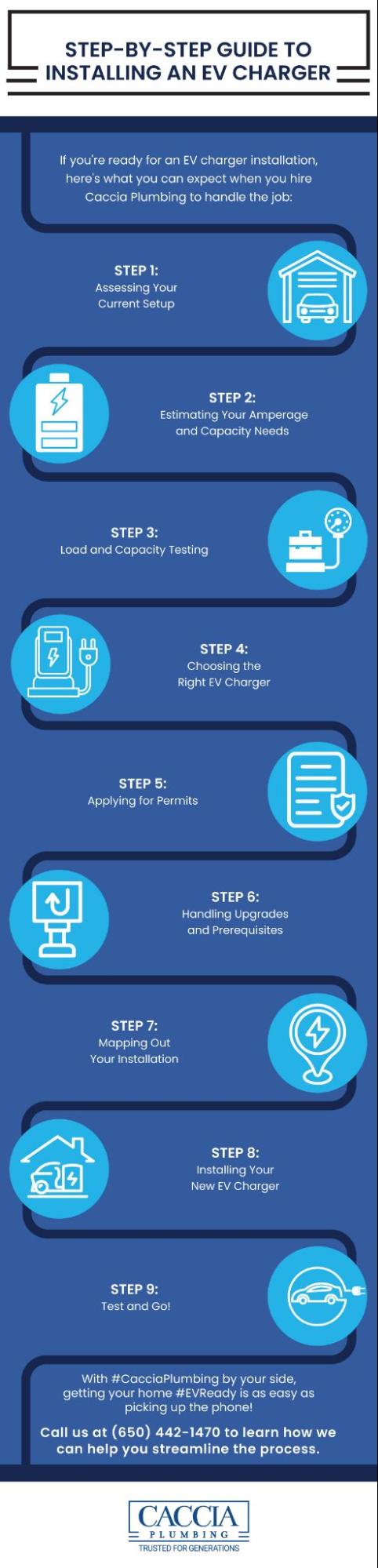
Permits and regulations can be a pain to navigate, but they help protect you from fines and low-quality work. The good news is we can make this part of the process completely painless for you by handling the application on your behalf!
Related: Installing an EV Charger in Your Garage: Safety Considerations & More

Ready to Power Up? Contact Caccia Today
In addition to providing top-notch plumbing services, Caccia Home Services can also help you with your household electrical needs, including EV charger installation! Our qualified electricians have years of experience handling work like this safely and efficiently, and have already installed thousands of chargers for people in San Mateo and surrounding communities.
Don’t sacrifice convenience or risk having to wait for a public device. Speed into the future with Caccia and schedule your EV charger installation today!
Frequently Asked Questions About Home EV Chargers
Can you get rebates for HEC in California?
Yes! California residents still have options to offset the cost of home charging, even with the federal EV purchase credit gone. These programs sometimes cover part or all of the cost of installing a new charger.
Here are a few worth looking into:
- PG&E’s Residential Charging Solutions Rebate offers a $500 to $1,000 install rebate on qualifying higher-powered chargers.
- Peninsula Clean Energy offers up to $500 per smart load-management device (max two per household), which can help you add a charger without a panel upgrade.
The 30C federal tax credit covers 30% of your charger and installation, up to $1,000, through June 30, 2026, but it only applies to homes in qualifying low-income or non-urban census tracts, so most Bay Area addresses won’t be eligible. You can check a specific address on the federal eligibility map.
Income-qualified San Mateo County residents may also be eligible for a Peninsula Clean Energy rebate of up to $4,000 toward a used plug-in hybrid or fully electric vehicle. For information about other rebates and opportunities to save, send us a message!
How much does installing an EV charger at home cost?
It depends on your situation. In general, most homeowners can expect to pay somewhere between $400 to $800 for a Level 2 charger and up to $2000 for installation. Factors like your current electrical system, your location, and local permitting fees can vary widely, so we strongly recommend working with one of our professionals if you want a more precise estimate. We always provide an upfront estimate of costs!
Can you DIY an EV charger installation?
No! Please don’t try to DIY this task on your own. Installing an EV charger might seem like a straightforward project for homeowners with the right skill set, but Level 2 chargers run on high-voltage systems that can be tricky, and very dangerous, to work on.
Trying to install your new charger yourself could lead to fires or damage to your writing and electrical panel. More importantly, you could also get hurt—and that’s the last thing we want to happen. Leave the job to us so we can keep you safe and ensure the work is up to code.
Can HEV Chargers be upgraded in the future?
Generally speaking, yes. There’s no reason you can’t upgrade your HEV charger in the future if you want access to new features, like super fast charging or multiple outlets.
Keep in mind that upgrades might require additional electrical work, and it’s only legal to start work after securing a permit. It’s best to consult with one of our licensed electricians before you start mapping out any future jobs.
How long does it take to install an EV charger?
Most installations are finished within around two to four hours if you don’t need any upgrades. If we need to adjust your electrical panel or wiring first, we’ll let you know in advance so you can plan for it. Call us at (650) 442-1470 if you want a more accurate estimate that’s specific to your home.
How do I know if my home can have an EV charger installed?
Nearly all homes in California have the capacity to support an EV charger. However, there are a few rare edge cases where a home or building may be unable to support one.
- Very old homes with older panels with knob-and-tube wiring
- Homes that lack an existing 240-volt circuit.
- Off-grid homes that rely solely on solar power.
- Tiny homes that lack the space for a charger.
- Properties with limited access to electrical service.
As long as your home has access to a standard wall outlet, you should be able to support a Level 1 charger either way. Let us know your situation and we’ll help you find a fix!