 (650) 442-1470


 (650) 442-1470
The situation
A blocked main sewer line is a big deal
The main sewer line carries wastewater from a home to the public sewer. When a blockage interrupts that flow, the first signs are often trouble flushing or slow drains. Eventually, sewage can start backing up into the home’s lowest fixtures.
That’s the kind of problem Caccia’s technicians are trained to address! In this case, Gio and Connor worked to clear the customer’s line through a drain cleanout in the pathing just outside the home. It gave them direct access to the entire sewer lateral without having to do any digging or excavation.
Why work through the cleanout?
It’s easier, cleaner, and more efficient to run a drain auger through a pre-existing line than to try and create a new access point or dig up the line completely. While it is technically possible to work from inside the home, it’s almost always more disruptive, and in some cases, may also require removing existing fixtures.
Peninsula sewer rules
Who’s responsible for your sewer lateral?
The answer depends on where you live! Here in Burlingame, homeowners are generally responsible for maintaining their sewer service laterals. But in Redwood City, the City maintains the lower lateral between the property line and the public sewer main, while homeowners handle the upper section.
Not sure who’s responsible? Start by contacting your city’s Public Works or Sewer Division, or your local sewer district. They can explain where your responsibility begins and ends.
Common warning signs of a main sewer line problem
Inside the job
Getting into the sewer line
Once Gio and Connor removed the cap on the cleanout, they could see standing wastewater inside. This is a clear indicator of a blockage somewhere in the lateral.
The first step was to set up the worksite by positioning the Spartan Tool Model 1065, a motorized drain-cleaning machine, nearby. Then, it was time to start feeding the device’s steel cable down the line.
The 1065 is a high-powered professional drum-style sewer auger you won’t find at your local hardware store. It features a durable steel cable that rotates a cutting head through the line, allowing it to bore into and break up obstructions. In the case of a particularly severe blockage, we can install special cutting heads onto the end to bust up the obstruction or even retrieve the material from it.
Clearing the blockage
The Spartan 1065 is ideal for jobs like this because it’s built to handle the larger pipes found in many main sewer lines. It’s compatible with both residential and commercial plumbing pipes between 3 and 10 inches in diameter and, with an extension cable installed, has a maximum reach of about 250 feet.
Gio and Connor carefully worked together to advance the cable through the line, adjusting their approach as they encountered resistance farther down the lateral. This helped them coordinate so they could react quickly if they ran into any issues or concerns along the way.
Why plumbers use professional drum augers
One challenge with snaking a sewer line is that the obstruction is completely out of sight. Technicians have to pay attention to how the cable responds, because resistance alone doesn’t automatically mean they’ve reached the blockage. Knowing when to advance, pull back, or change their approach is just as important as properly controlling the machine’s powered cable feed.
Flushing and cleanup
Restoring the flow
As Gio and Connor continued working through the blockage, the standing wastewater inside the cleanout began to recede. A falling water level is a clear sign that wastewater can finally flow through the line again.
Seeing the water level drop is encouraging, but a partial clog will still allow some water to pass through the drain. That’s why the next step is always to thoroughly test it by introducing fresh water to confirm the flow. Water that immediately begins to pool up again tells us that either there’s still an obstruction, or there’s something else going on at the same time.
Gio and Connor used a standard hose to flush additional water through the cleanout next. They also washed away any loosened debris at the same time and cleaned the area directly around the cleanout access to eliminate any remaining splashback.
Safety first
Why this isn’t a DIY-friendly job
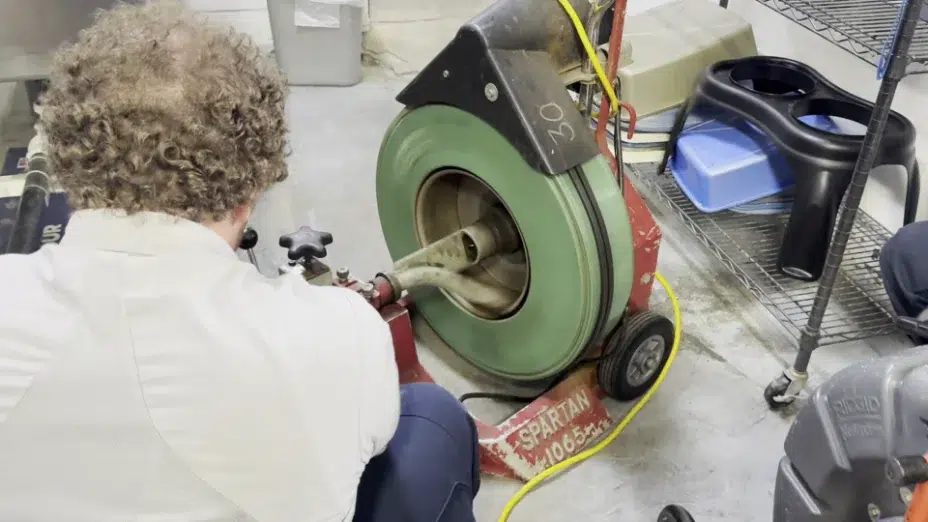
The trusty Spartan 1065 in use on a different service call. See our pet hospital case study for more info on how it helped us resolve a different clog for the customer.
A sewer auger isn’t the same as the smaller hand-cranked drain snakes available in most hardware stores. The steel cable generates significant torque, especially when the cutting head encounters resistance. If that torque builds up without proper control, the cable can buckle, twist, or whip around, potentially causing serious injuries or damaging the equipment.
This is one of the reasons why we often send two technicians to the job site: one to work the line, and one to man the auger itself in case they need to shut it down quickly. Spartan’s own safety guidance states that only trained operators should even attempt to run the 1065 for any job, no matter how simple it seems.
After the cleaning
What happens after clearing the line?
Removing the blockage won’t permanently address many of the root causes that lead to clogs in the first place. In some cases, we may also recommend a sewer camera inspection before or after so we can visually inspect the cleared line for problems.
The results
Drainage restored during the same visit
Before leaving, Gio and Connor made sure the worksite was clean and moved the auger back onto the truck. The customer was immediately able to start using their sinks, toilets, showers, and other plumbing fixtures normally. Clearing the obstruction also reduced the immediate risk of sewage backing up into the home, which can cause thousands of dollars in damage.
At Caccia, this is our main goal on every service call: diagnose the problem, resolve it, and leave the worksite in good condition so customers aren’t left with a mess on their hands or in their plumbing.


